
From Suicidal Thoughts to Workplace Mental Health Startup: Asim Amin & Plumm
"The help that I was trying to seek was, can you lend me money? Can you help me get out of this situation? But the help that I really needed was from a mental health perspective. I didn't know how to regulate my emotions."
"I believe we're really sitting in a mental health epidemic. And I think the onus is not on the NHS or on the therapist or on thought leaders or on Plumm even. I think the onus is really on us."
"COVID is not going to take as many lives as suicide does every single year. Like, it's crazy. It was a pandemic, but we are sitting on a health epidemic."
"The biggest challenge when it comes to mental health or getting support is not the support itself. It's you first acknowledging that there is a problem, and then taking that first step, asking for help, that is really the hardest."
"Me sharing this again, the stage that I was in and just seeing how far I've come, that is really empowering. You've taken me on a mini therapy session at this point in time, which is just fantastic."
Asim Amin, the founder of Plumm, opens up about standing on the edge of his balcony for three consecutive days, how cultural stigma in Dubai made seeking therapy feel impossible, and how that personal crisis became the catalyst for building a mental health and HR platform now serving thousands of employees worldwide.
What you'll learn
- Suicidal ideation is often situational and in-the-moment rather than planned; real-time support is therefore more critical than post-crisis intervention.
- Cultural stigma around mental health, especially for men from Indian and Middle Eastern backgrounds, can prevent people from seeking help even when they know it is available.
- A therapist cannot solve your problems for you; their role is to help you regulate emotions and think clearly so you can solve problems yourself.
- Pivoting from B2C to B2B shifted Plumm's focus to corporate wellbeing, where the employer bears the cost and employees gain subsidised access to therapy.
- Building an all-in-one HR platform allowed Plumm to reposition mental health from a "nice-to-have" to a built-in component of essential workplace software.
- AI chatbots in mental health are disproportionately used by men, suggesting they lower the barrier for those who would not otherwise seek human therapy.
- Sharing your own mental health journey normalises the conversation for others and is itself therapeutic, a feedback loop that reinforces both individual and collective wellbeing.
Key moments from the conversation
Three days on the balcony edge
After losing significant money in the Dubai property market and finding himself financially negative, Asim stood on his balcony contemplating suicide for three consecutive days. His fear of heights and a clear memory of watching his mother transform through therapy were the two factors that ultimately stopped him.
Hidden therapy in a stigma-saturated culture
As an Indian man living in the Arab world, Asim was so ashamed of seeking therapy that not even his mother, herself a therapist, knew for four years. The revelation, when it came, became one of the most emotionally bonding moments of their relationship.
COVID as Plumm's inflection point
Companies that had rejected Plumm's mental health pitch before the pandemic began calling during it. COVID created an overnight shift in corporate appetite for employee wellbeing, turning a slow-burn B2B market into an urgent one.
Pivoting to HR to survive the downturn
When post-COVID budget cuts led companies to treat mental health as a luxury, Plumm interviewed its HR clients and discovered pain points around fragmented software, high admin burden, and siloed data. The result was an all-in-one HR platform that subsidises therapy within a must-have tool.
Men and the AI chatbot therapy gap
Plumm's data revealed that men engage with its AI chatbot therapist at higher rates than women, and that some men who had never tried any form of therapy began using the chatbot as a first entry point into mental health support.
Frequently asked questions
What is Plumm and how does it help employees?
Plumm is an all-in-one HR and mental wellbeing platform. It embeds subsidised access to therapy and coaching within an HRIS product covering payroll, ATS, and LMS functions, so that mental health support comes as a default rather than an optional add-on.
What was the turning point that led Asim Amin to start Plumm?
A financial collapse in his property business led to severe depression and three days of suicidal ideation. After recovering through therapy, Asim felt compelled to make mental health support accessible to others and launched Plumm in 2018.
How does Plumm use AI in mental health care?
Plumm has an AI chatbot that provides immediate support between human therapy sessions, triages users based on risk level, and flags high-risk situations for human oversight. It is designed as a bridge to, not a replacement for, one-to-one therapy.
Why did Plumm pivot from B2C to B2B?
The high cost of therapy made direct-to-consumer uptake slow. By shifting to corporates, Plumm placed the financial burden on employers and embedded therapy within workplace benefits, where most adults spend the majority of their time.
Who is Asim Amin?
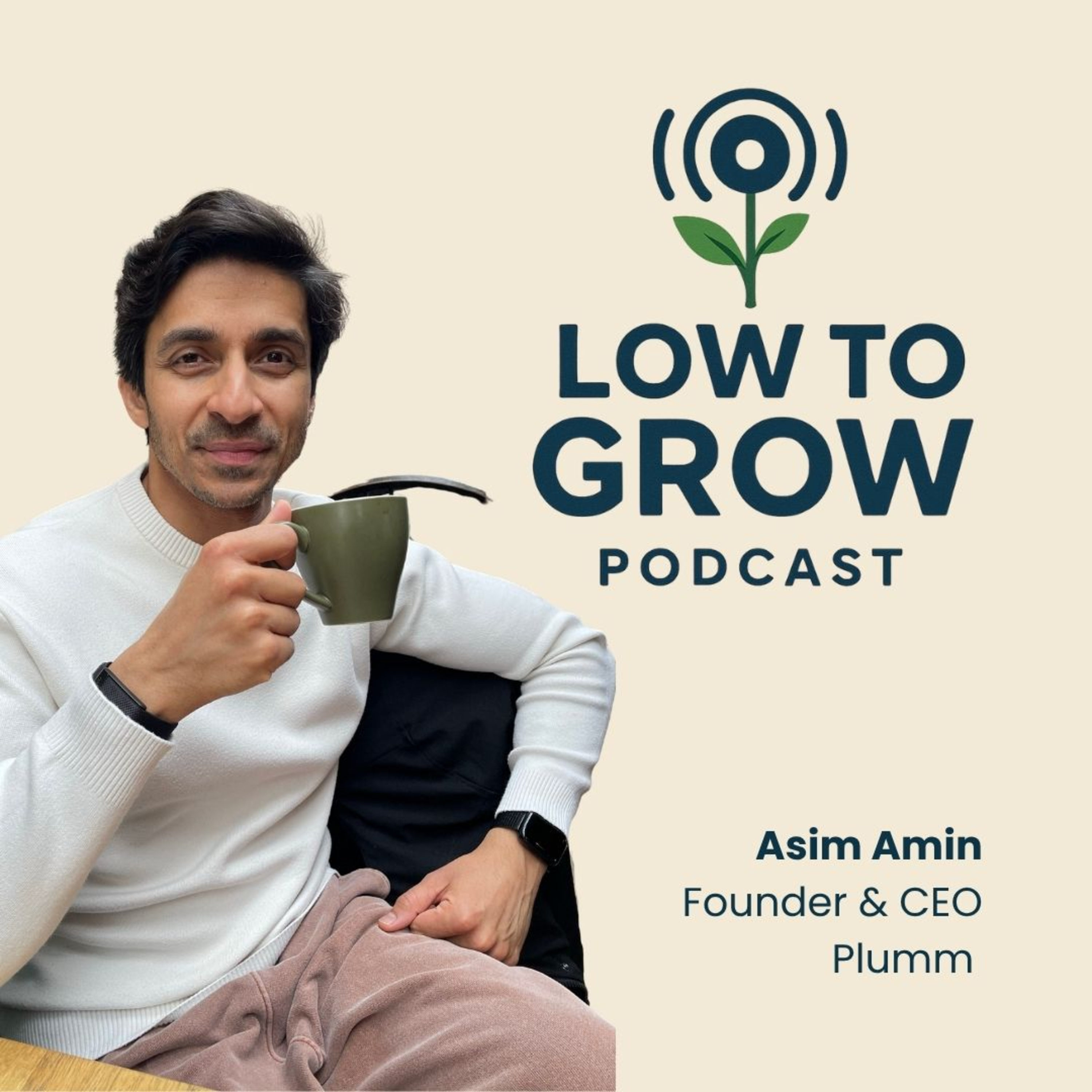
Asim Amin
Founder & CEO · Plumm
After witnessing firsthand how mental health challenges affected my own family, I knew something had to change, starting with how we access mental health support at work. My journey, marked by setbacks and breakthroughs, showed me that true success is rooted in resilience and wellbeing. That's why I founded Plumm. What started as a mental health service has now evolved into a full-service HR solution, with mental health at its core. No HR strategy can thrive without it. As host of the Immigrant Founders Pod, I share stories of resilience and success, offering insights from entrepreneurs who've defied the odds.
Continue listening
More episodes

2026-06-07
Eileen Wada Willett of East Asian Girl Gang: A Third Culture Take on Identity, Fashion and Community
Listen →
2026-05-24
Dhritiman Mitra Investment Banker and Political Strategist: Insights on Harnessing AI for India's Future
Listen →
2026-05-10