
Ahana Banerjee on Founding Clear: Beauty Tech, Acne & Female Founder Fundraising
"I think I have experienced more failure than most people know. It's just I swing a million times. And that 0.01% that I actually hit the ball is the one that you see on the LinkedIn profile."
"I only take measured risks and I don't believe that to succeed, you have to take massive crazy swings and put all your eggs in one basket."
"Fundraising has probably been the hardest part of my journey. It's also what completely changed my opinion and shattered my worldview on what it meant to be a female founder and specifically a young Asian female founder."
"I adopted the mindset that most companies fail. I'm not doing this to succeed. I'm not doing this to be on the Forbes 30 under 30. I am doing this because what I want to optimize for at this stage of my life and my career is learning and personal development."
"I am way more disciplined and way more resilient and able to deal with failure, being bad at things than your average person. And that has been the key to every success I've ever seen, whether in work or in life, fitness, sport, everything."
"The three most important things to me are: number one, those closest relationships. Number two is actually my health. And number three is my career and what I achieve. And those are my non-negotiables."
Ahana Banerjee, the Y-Combinator-backed founder of Clear, shares how moving between the UK, India, and Singapore shaped her drive for social impact, how she overcame academic self-doubt at Imperial to discover entrepreneurship, and what it really takes to fundraise as a young Asian female founder.
What you'll learn
- Moving countries as a teenager, from the UK to India to Singapore, gave Ahana early exposure to extreme inequality, fuelling her drive to use her education to create impact.
- Y-Combinator has a standard online application; you do not need existing investor connections to get funding consideration.
- Negotiating two-year deferrals on graduate job offers allowed Ahana to pursue Clear without risking financial ruin, a calculated, measured approach to risk.
- Hiring errors included over-indexing on age and prestigious university names; what mattered most was startup-relevant, self-sufficient experience.
- Values alignment between co-founders matters more than shared hobbies, shared work ethic, love of learning, and approach to problem-solving are the real glue.
- Experiencing rejection from investors, over 200 pitches, can still yield learning; reframing rejection as proof you are operating in a hard space preserves motivation.
- Self-awareness about your value system, knowing your top three non-negotiables, makes daily decision-making easier and protects mental health under pressure.
Key moments from the conversation
The privilege epiphany at 14
Moving from a UK state school to an international school in New Delhi confronted Ahana with extreme socioeconomic contrast for the first time. Witnessing poverty while surrounded by peers whose parents were CEOs and ambassadors created a lasting sense of responsibility to do something meaningful with her education.
Losing confidence at Imperial, and getting it back
A competitive peer group at Imperial College systematically undermined Ahana's confidence, leaving her feeling she was not smart enough. The turning point came when those same peers could not convert their academic excellence into job offers, revealing that grades and workplace competence are distinct skills.
The measured leap into entrepreneurship
When Y-Combinator offered to invest, Ahana strategically negotiated a bachelor's exit from her integrated master's and secured two-year deferrals from her graduate finance offers. This gave her a safety net that let her take the risk without betting everything on a single outcome.
Finding a CTO on Reddit
After several failed hires, Ahana found her CTO Charles, also a physics graduate from Imperial, through a Rust forum. Their complementary skills, first-principles thinking, and shared values around discipline and freedom transformed the company's velocity.
Fundraising as a young Asian female founder
More than 200 investor pitches reshaped Ahana's worldview on gender and racial bias in venture capital. The experience was painful but also clarifying, pushing her to look at data and reflect on systemic issues beyond her individual situation.
Frequently asked questions
How did Ahana Banerjee start Clear?
Ahana started Clear while still at university, initially as a side project during COVID. She applied to Y-Combinator without expecting much, and they invested when Clear was a four-day-old idea, which enabled her to leave her degree and work on the company full-time.
What is the Clear skincare app and who is it for?
Clear is a beauty tech app that helps consumers figure out which skincare products to use and whether they are actually working. It was built to solve Ahana's own decade-long struggle with cystic acne across multiple countries and healthcare systems.
How did Ahana Banerjee raise funding for Clear?
Ahana applied to Y-Combinator through their standard online application and was accepted. She then completed over 200 investor pitches to raise further venture funding, experiencing the biases that face young female founders of Asian heritage.
What advice does Ahana give to aspiring entrepreneurs?
She advises putting yourself in positions of discomfort and treating rejections as evidence you are pursuing something hard. She also stresses self-awareness: know your value system and non-negotiables so that decision-making becomes easier under pressure.
How did Ahana Banerjee balance risk when starting her company?
She negotiated an early exit from her integrated master's to keep her bachelor's degree and secured two-year deferrals from two finance graduate offers, ensuring she had a financial safety net if Clear failed.
Who is Ahana Banerjee?
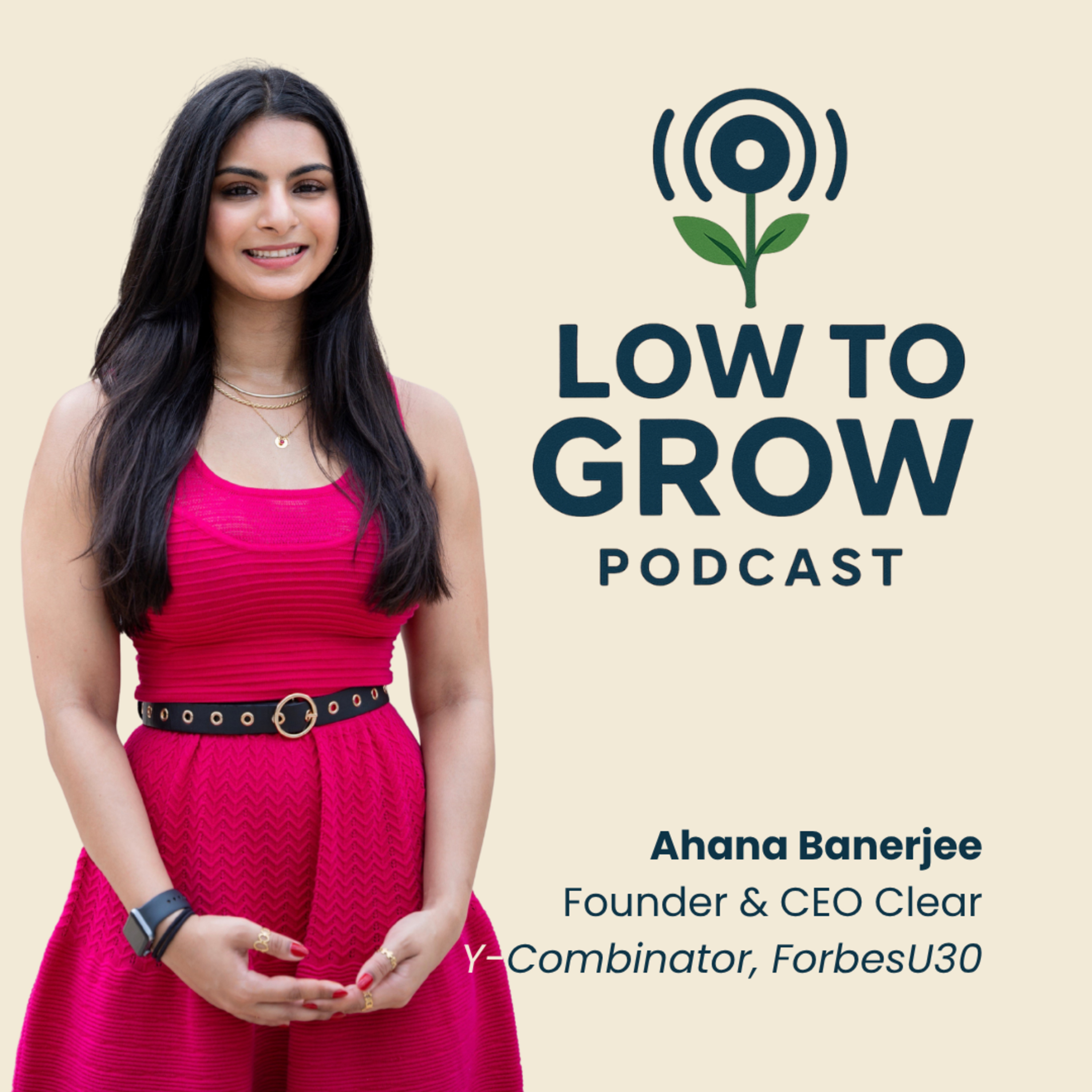
Ahana Banerjee
Founder & CEO · Clear
I am a 26-year-old founder, Forbes 30 Under 30 technology honouree, Sunday Times Young Power List 2024 honouree, and physics grad from Imperial College London. My work has been featured by the likes of Sifted, Courier Magazine and EU-Startups, and I have been a speaker at numerous conferences and universities, including Oxford, Cambridge, Bocconi and IIT. My company, Clear, is fuelling innovation for brands and empowering consumers in the skincare industry using data, technology and community. I was accepted to Y Combinator (W21) with the idea and subsequently raised ~$1M in venture funding for the company. We have been recognised for our beauty-tech innovation by L'Oréal and Beiersdorf, and were recognised by Apple under "Best New Apps" and "App of the Day" on the App Store.
Continue listening
More episodes

2026-06-07
Eileen Wada Willett of East Asian Girl Gang: A Third Culture Take on Identity, Fashion and Community
Listen →
2026-05-24
Dhritiman Mitra Investment Banker and Political Strategist: Insights on Harnessing AI for India's Future
Listen →
2026-05-10