
Erika Brodnock MBE: KinHub and her Entrepreneurship Story
"Dory the little blue fish in Finding Nemo says, just keep swimming, just keep swimming. And that, I regularly do that in my mind, just so that actually you just keep going even in the face of adversity, because eventually you kind of have to get to, if you were thinking about a dice, you would have to roll a six at some point."
"I genuinely believe that everybody in the world should have coaching and should have access to coaching. But there aren't enough coaches for that to be possible. So augmenting a service like this means that you're able to turn around and enable coaches to see more people."
"I looked at the data to understand whether other people that looked like me also weren't a good fit. And that was when I was able to really say, actually, I don't think this is a me problem. I think this is an industry problem."
"Understanding the power of no, as well as collecting yeses, is really important, embracing that you can say no and still move forward, and that it can impact you positively because you've taken time to prioritise yourself."
"If you come from a non-traditional background, you may have to realise that your journey will be slightly different to the status quo. Pacing yourself for a sprint is completely different to pacing yourself for a marathon."
Erika Brodnock MBE, co-founder of the AI coaching platform Kinhub and a PhD graduate of LSE, went from a three-month Jobcentre contract and buying her first home at 19 to becoming a multi-award-winning entrepreneur, angel investor and academic. She tells Annie how being the 'only one in the room' in tech taught her to look past personal rejection to systemic data, why coaching (not just therapy) changed her life, and how she is working to democratise the kind of support usually reserved for the privileged. A must-listen for any young professional from a non-traditional background building a career on their own terms.
What you'll learn
- Why Erika reframes a 'non-traditional background' as an advantage rather than a disadvantage
- How looking at the data turned her VC rejections from a 'me problem' into 'an industry problem'
- The difference between coaching and therapy, and why she tells everyone to get a coach
- How to choose a coach or therapist you genuinely click with, including the body signals to trust
- Why she chose to heal rather than medicate after a mental health diagnosis
- How Kinhub's buy-three-give-one model brings coaching to people who would never otherwise access it
- Why the therapy-averse, especially men, often open up more easily to an AI coach than a human one
- The three eight-hour segments, work, rest and play, and why protecting rest is the antidote to burnout
Key moments from the conversation
Capability over labels: from a three-month contract to one of the youngest managers
Erika's first job was a three-month casual contract at a Brixton Jobcentre with queues out the door. Within weeks she had redesigned the appointment system into timed 15-minute blocks, eliminating the two-hour waits, turning her contract permanent and earning promotion to team leader, one of the youngest the organisation had seen. She describes it as a place where it did not matter that she was young, female or black; it mattered that she was capable, a foundation that shaped everything after.
Square peg, round hole: when the tech industry stopped fitting
After years of having her ideas celebrated and rewarded, Erika hit a wall building her edtech startup Charisma Kids in 2012. No matter how much revenue she made or how many deals she signed, VCs always found a new reason to pass. She describes trying to contort herself, 'a square peg in a round hole', to make herself as round as possible, and still not being a good fit. That experience, familiar to anyone who has been the only one who looks like them in the room, sent her looking for answers in the data.
Not a 'me problem', an industry problem: letting the data reframe rejection
Rather than internalise the rejections, Erika looked at whether other founders who looked like her were also being turned away. The data was unequivocal: 'I don't think this is a me problem. I think this is an industry problem.' It is a reframe with real power for young professionals, shifting the emotional weight of repeated 'no's from personal inadequacy to a structural reality you can name and work to change.
The deal that collapsed three days before close
A fund set up specifically to back female founders inserted a clause three days before signing that would have permanently stripped Charisma Kids' founders of 50% of their shares. When Erika discovered none of the fund's other (non-black-female) portfolio companies had received that clause, she walked away. She calls it her first heartbreak in tech, and the moment she truly understood that all founders are not created equal.
Choosing to heal, not just medicate
Erika's coaching journey began with a mental health diagnosis in her twenties. Faced with the prospect of medication for life, she decided there had to be another way, exploring coaching, emotional freedom technique (tapping), acupuncture and other modalities, and eventually training as a coach herself. For listeners from cultures where mental health is rarely discussed, her route from diagnosis to healing to helping others is a quietly radical one.
Charlie and the therapy-averse: why an AI coach lowers the barrier
When Kinhub launched its AI coaching agent, Charlie, corporate clients predicted nobody would use it. The opposite happened: a wave of users would only speak to Charlie and never book a human. As Erika explains, with an AI there are no 'airs and graces', no need to perform being a caring parent or a strong man before getting to the point. For people who would otherwise bottle things up until fever pitch, it became a safe, low-stakes entry point into support.
Pacing for a marathon: rest, play and the power of no
Erika is candid that she became unwell from working through all three of the day's eight-hour segments and ignoring the signs she needed rest. Her advice: treat rest and play as non-negotiable, and learn the power of saying no, politely, with compassion, and still moving forward. If you come from a non-traditional background, she says, your journey may simply take longer, and pacing yourself for a marathon rather than a sprint is what keeps you in it for the long term.
Frequently asked questions
Who is Erika Brodnock MBE?
Erika Brodnock MBE is a British multi-award-winning entrepreneur, philanthropist and angel investor, and co-founder of the AI coaching platform Kinhub. She holds an MBA and a PhD from the Inclusion Initiative at LSE, is a Royal Society Entrepreneur in Residence at King's College London and a Leadership Fellow at the University of Exeter, and previously founded the children's edtech app Charisma Kids.
What is Kinhub and how does it work?
Kinhub is a work-life intelligence platform that augments human coaches with AI. It features Charlie, an AI coaching agent; sentiment and emotion modelling based on language and typing behaviour; personality profiling to personalise the experience; and a buy-three-give-one funding model, when an organisation pays for three employees to access coaching, Kinhub provides free coaching via charities to someone from a low-income background who could not otherwise afford it.
What is the difference between coaching and therapy, according to Erika Brodnock?
Erika describes coaching as more direct and action-oriented, focused on moving you forward toward a specific outcome, while therapy tends to explore the reasons behind feelings and past experiences at a slower pace. She is a strong advocate for coaching and recommends that everyone get a coach.
How do you choose the right coach or therapist?
Erika advises looking for congruence and genuine resonance: you should feel a sense of joy at speaking with them, and trust them enough to accept hard truths. She also says to tune into your body, if it feels sticky or knotty in your tummy, it is often not the right fit, and that building trust and rapport quickly matters even more with a therapist than a coach.
Why did Erika Brodnock prefer an MBA over her MBE?
Asked to choose instantly, Erika picked the MBA. While she is grateful to have been honoured with an MBE, she says nothing surpasses knowledge and understanding in this world, and an MBA represents exactly that.
What did Erika Brodnock's LSE research find about black women's pay?
Through her PhD at LSE's Inclusion Initiative, Erika worked on research into why black women are the least likely to feature in the top percentile of earners in the City of London, pointing to a pay gap of up to 40%. Her motivation is partly that higher earnings create more black angel investors, broadening the first layer of capital available to black founders, who often lack the friends-and-family funding others rely on.
Who is Erika Brodnock MBE?
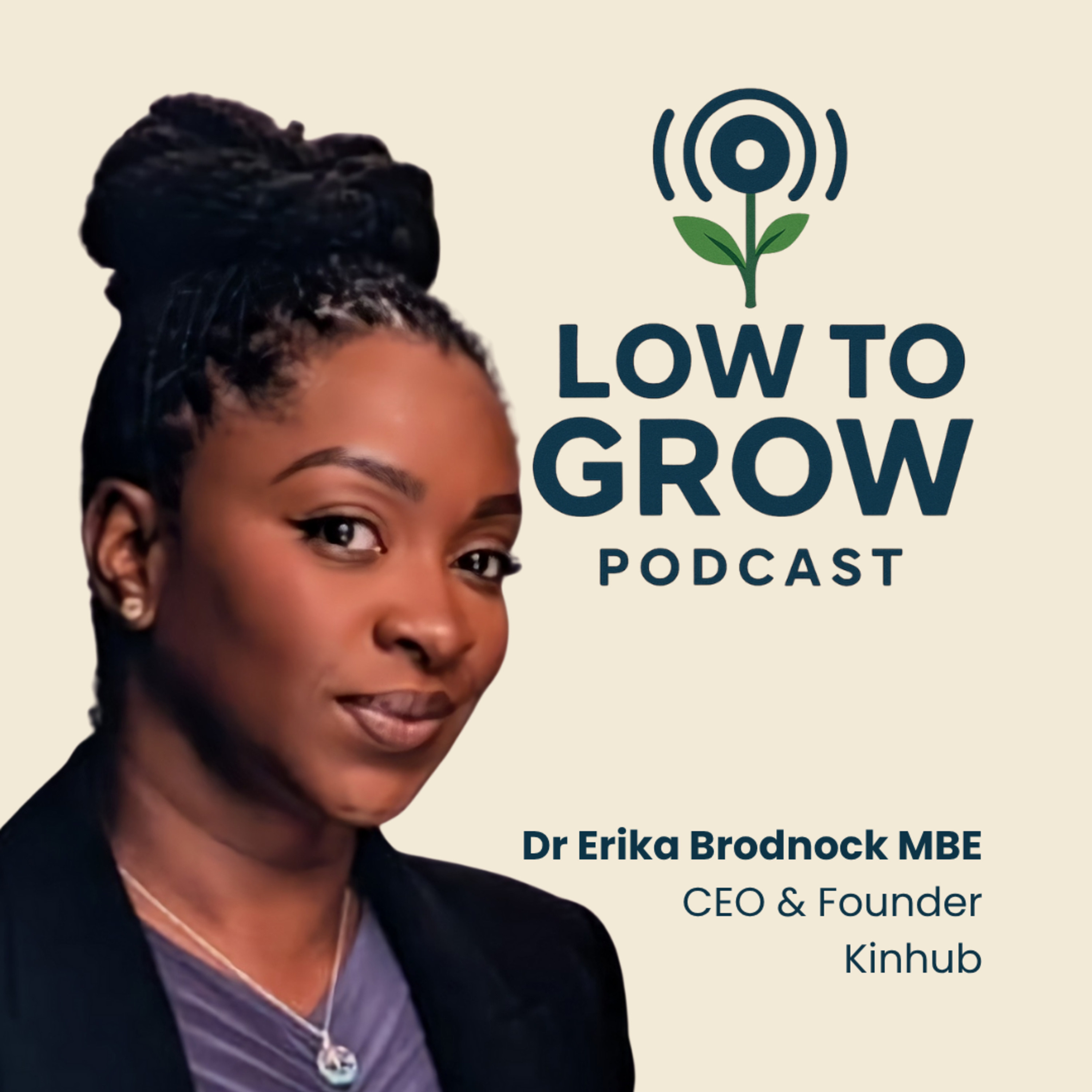
Erika Brodnock MBE
Co-Founder & CEO · Kinhub
Erika Brodnock, MBE is a multi-award-winning entrepreneur, philanthropist, and angel investor. She is also an MBA, a Royal Society Entrepreneur in Residence at King's College London, a Leadership Fellow at the University of Exeter, and holds a PhD from the Inclusion Initiative at the LSE. She authored Diversity Beyond Gender and co-authored the TRANSPARENT Framework and Better Venture, Improving Diversity, Innovation, and Profitability in Venture Capital and Startups. Erika is the co-founder of Kinhub, a Work Life Intelligence platform helping organisations boost productivity, performance, and retention through AI-powered coaching and support. She is also a non-executive director at Diversity VC and The Good Play Guide; a trustee for the Black Funding Network; an investment committee member for Resonance Community Fund; and serves on the advisory boards for the APPG for Entrepreneurship and Oxford Brookes Business School.
Continue listening
More episodes

2026-06-07
Eileen Wada Willett of East Asian Girl Gang: A Third Culture Take on Identity, Fashion and Community
Listen →
2026-05-24
Dhritiman Mitra Investment Banker and Political Strategist: Insights on Harnessing AI for India's Future
Listen →
2026-05-10